You are known as

Connecting…

Discoverable on this network
Invisible Mode Only paired contacts can see you

Looking for nearby devices...

Open anydrop.org on other devices to share instantly. Use the Magic Link to speed up Wi-Fi pairing or connect across the internet. No Installs. No Setup.

Waiting for trusted contacts...

Ensure your paired contact has AnyDrop open. To connect with a new device while hidden, add them as a contact.

Scanning network...

000000

AnyDrop

v4.3.1

Share files, chat, notes, and snippets instantly across any device or platform. No installs. No setup. Just open and connect.

How to use AnyDrop

  • Connect: Devices on the same Wi-Fi appear automatically.
  • Magic Links: Use the link icon to connect with devices across the internet.
  • Share: Click a device to open the chat to share texts, files, or voice notes.

Privacy at a Glance

  • Direct Transfers: Your files never touch our servers. We use WebRTC to build a direct bridge between your devices, then we get completely out of the way.
  • Self-Destructing Links: Your shared links only work while your screen is open. Close the tab, and the link is gone forever.
  • Always Encrypted: Even on tricky public Wi-Fi, your transfers are locked down and unreadable by anyone else.
  • Cookie-Free Zone: We don’t track your behavior, profile you for ads, or sell your data. You can use the app completely under the radar without anyone looking over your shoulder.
Support AnyDrop Give Feedback Crafted by Gemshi Gemshi 2026

Back to About

Help & FAQs

Everything you need to know about using AnyDrop securely.

Help Guide

AnyDrop is designed around privacy by default. Your files and messages are shared through a direct, end-to-end encrypted connection between devices, not stored on our servers. Because every chat and transfer is device-to-device, both devices must have AnyDrop open and online at the same time for sending to work. There is no server copy to pick up later. No accounts, no passwords, no tracking. Just simple, secure sharing across platforms. We only help devices find each other; your data stays on your devices.

1. Getting Connected

Local Network: Open AnyDrop on two or more devices on the same Wi-Fi network. They instantly discover each other and appear on screen.

Magic Links: Tap the Share icon in the top menu to generate a secure Magic Link or QR code to pair devices over the internet.

2. Sending Files & Chatting

Tap any discovered device to open an end-to-end encrypted chat thread.

Drag and drop single or multiple files and folders, or use the paperclip icon to send files, or the microphone icon for quick voice notes. Folders are zipped automatically for smooth delivery up to 500 MB. For larger folders, please zip them manually first before sending.

Transfers show synchronized real-time progress so both sides can track delivery. On supported desktop browsers (Chrome, Edge, and other Chromium-based browsers), very large incoming files can be streamed straight to your hard drive — when you tap Accept, your browser will ask where to save the file or folder so it never has to sit entirely in memory.

Both devices must stay active: A transfer or live chat only works while each device has AnyDrop open in the browser (or as an installed PWA) and can reach the other. Closing the tab, locking the screen for a long time, or going offline may pause or end the connection. AnyDrop now reconnects more reliably when you return to the app, but both sides still need to be online together to send or receive.

3. Clipboard Staging (Paste Anywhere)

AnyDrop includes a smart Clipboard Staging area for links, notes, and quick copy snippets.

Paste text or URLs anywhere in the app (Ctrl + V or Cmd + V) and they are captured into Staged Snippets automatically, so you can review, copy, or share them without losing context.

4. Shared Notes Across Devices

Open the Notes tab to write collaborative notes that sync live between your connected devices and peers in the same session.

This is ideal for temporary checklists, shared links, or quick handoff of text snippets to every device connected.

5. Invisible Mode & True Privacy

Toggle Invisible Mode from the Connect screen to hide your device from strangers on public Wi-Fi. Only contacts you explicitly paired with can discover you.

6. Install AnyDrop as a PWA App

On iPhone (Safari), tap Share and choose Add to Home Screen (scroll down in the Share sheet if you do not see it). On Android, open the browser menu and tap Install app or Add to Home screen. The in-app Install button is typically available in Chromium-based browsers (like Chrome and Edge) when your browser detects AnyDrop can be installed.

7. Uncompromising Security & Privacy

No Cloud Storage: Files move device-to-device and are never uploaded for storage.

End-to-End Encrypted: Data is encrypted in transit on both local and internet connections.

Zero Digital Footprint: No accounts, no passwords, and no persistent tracking profile.

Frequently Asked Questions

Is there an official AnyDrop Android or iOS app in app stores?

No. AnyDrop is web-only. There is no separate official Android or iOS app in app stores. The only official AnyDrop is anydrop.org.

Does AnyDrop store my files or chat history on a server?

No. AnyDrop is peer-to-peer. Servers only handle signaling so devices can find each other; they do not store file contents or chat logs.

Do both devices need to stay online and open?

Yes. AnyDrop does not keep your files or messages in the cloud. Each send is a direct connection between the two devices, so both must have AnyDrop open and online at the same time for a transfer or chat to work. If one device closes the app, sleeps, or loses network, the other cannot receive until you are both active again.

What are the file size limitations?

Limits depend on your network path and browser:

  • Same Wi-Fi / local network: You can usually send files of any practical size. AnyDrop prefers a direct device-to-device connection whenever possible.
  • Across the internet (relay): When a direct route is not possible and traffic must go through a relay (common on hotel or public Wi-Fi), individual files larger than about 50 MB may be blocked. Try both devices on the same Wi-Fi if that happens.
  • Desktop (Chrome, Edge, and other supported browsers): Files larger than about 1 GB are streamed directly to disk when you accept them — your browser asks where to save the file or folder. Smaller files are assembled in memory and shown in chat for download.
  • iPhone, iPad, and most mobile browsers: These browsers do not support direct-to-disk saving. Files over about 200 MB cannot be received safely and will be declined automatically to prevent the tab from crashing. Send large files to a desktop browser instead, or split them into smaller parts.
  • Desktop Firefox or Safari: Without direct-to-disk support, large files fall back to in-memory assembly. Very large transfers may still be limited by available RAM — Chrome or Edge on desktop is recommended for multi-gigabyte files.

How do I transfer files from iPhone to a Windows PC?

Because AirDrop does not work on Windows, AnyDrop acts as the bridge. Open anydrop.org on both your iPhone and PC browser. The devices will instantly discover each other over your local Wi-Fi, allowing you to drag and drop files directly between them.

What happens if I cancel a transfer midway?

Canceling tears down the connection and stops the transfer immediately. For small files held in memory, in-flight data is discarded. For large files being streamed to disk, the partial file is aborted and removed by the browser — nothing half-written is left behind.

I received a file, but can't find it. Where is it?

It depends how the file was received:

  • Large file saved to disk: If your browser asked you to choose a save location when you tapped Accept, the file is already on your hard drive in the folder or path you picked. The chat will show Saved to device — no extra download step is needed.
  • Smaller file in the browser: Browsers cannot silently save files to disk. After the transfer completes, tap the download icon in chat to save permanently. If the app or tab closes before you download, the temporary in-memory copy is removed.

Can I automatically accept files without clicking 'Accept' every time?

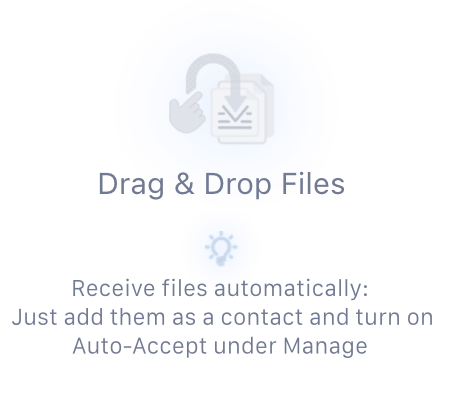
Yes, you can set trusted devices to Auto-Accept. Because AnyDrop is built for privacy, you cannot globally auto-accept files from strangers. To enable it for a specific person or device:

  1. Make sure you have added them as a Contact.
  2. Open your chat thread with them.
  3. Open the Manage button in that chat and toggle on auto-accept for their device (or use Manage contacts from the Chat header).

Files they send will download immediately when the app is open — as long as the file is small enough to fit in memory. Very large files (over about 1 GB on desktop, or 200 MB on mobile) require you to tap Accept manually so your browser can show a save dialog and choose where to store the file on disk. Auto-Accept is bypassed for those transfers by design.

Why did AnyDrop ask me where to save a file?

For large transfers, AnyDrop streams data directly to your hard drive instead of loading the entire file into browser memory. Your browser's security rules require you to pick a save location yourself — this happens when you tap Accept, before the transfer starts. For a single large file you choose the filename; for a batch that includes large files you choose a folder and each file is saved inside it.

Why does Chrome show a warning that says "This site can see edits you make" when I save a 1 GB+ file?

That is a built-in security feature of Google Chrome. Because AnyDrop streams massive files directly to your hard drive (which prevents your browser from freezing or crashing), Chrome wants to make sure you explicitly approve the action.

When you see this warning, it simply means Chrome is double-checking that you want to allow AnyDrop to write the incoming file to the specific folder you just selected. AnyDrop cannot see, edit, or access any other files on your computer — it only has permission to save the file you are currently receiving.

What happens if a transfer gets stuck and I close the app?

AnyDrop recovers on next launch by cleaning interrupted transfer state and marking stale entries as canceled so chat history stays accurate. If a device was asleep or offline, bring both sides back online and open AnyDrop — connections and discovery should resume automatically. For a transfer that failed mid-way (for example, disk full), you may need to send the file again.

Are my files uploaded to the cloud?

No. AnyDrop creates a direct encrypted transfer path between devices rather than uploading files to third-party storage.

Who can see the files I am sharing?

Only the peer you are actively sharing with. Files are protected by direct connection flow and encryption in transit.

What data does AnyDrop collect about me?

AnyDrop is sign-up free and designed for minimal metadata. Routing information is temporary and only used to establish peer connectivity.

Is AnyDrop safe on public Wi-Fi?

Yes. Transfers remain encrypted, and you can enable Invisible Mode to stay hidden from unpaired users on the same network.

What do the chat message status icons mean?

Single check: your message is still sending.
Double check: message delivered to the other device.
Green double check: message was read.
X icon: message failed to send.

How do I delete a chat thread?

Open the chat thread you want to remove, tap the three-dot menu in the chat header, and select Clear this chat. This clears the conversation and removes that device from your recent chat list.

How do I share copied text between Mac and Android?

Simply open AnyDrop on both devices and click on your paired device to open the Chat view. You can paste any clipboard text or links into the chat, and it will instantly sync to the other device using peer-to-peer encryption.

I can't see nearby devices. What should I do?

First make sure both devices are on the same Wi-Fi and AnyDrop is open. If discovery still seems stuck, refresh the page on both devices and wait a few seconds for scanning to restart. If that still does not work, manually pair by adding the device as a contact from the Chat tab, or use the link option in the top bar.

Why does my transfer get stuck at "Device Connected"?

If your devices successfully discover each other but the file transfer refuses to start, a strict ad-blocker or local VPN is likely blocking the connection.

Privacy tools like AdGuard feature Tracking Protection (or Stealth Mode) specifically designed to block WebRTC. Because AnyDrop relies entirely on WebRTC to build a secure, peer-to-peer bridge between your screens, this strict blocking instantly kills the transfer. To fix this, simply add anydrop.org to your privacy tool's Allowlist, or temporarily disable the "Block WebRTC" setting.

Need help or want to share feedback? Contact

Related Guides